
AIIS is pleased to announce the successful completion of four student Digital India Learning (DIL) fellowships for digital sonic and visual projects for the summer of 2024. The fellows carried out original projects using the resources of the two AIIS research centers in India (Archives and Research Center for Ethnomusicology (ARCE) and Center for Art and Archaeology (CA&A)) and resulting in the creation of a digital exhibition, digital curriculum, or other creative products intended for varied audiences presented on the Virtual Museum of Images and Sounds (VMIS). The goal of this opportunity is to: foster the digital production and dissemination of knowledge about India; promote the creation and use of digital resources and media for the study of India; and promote digital collaboration. This is the third year that AIIS has offered this opportunity.
From John Weaver’s VMIS exhibit
The four fellows are:
Sophia Kingsbury for the project “Ephemera Speaks to Dance: A Journey Through the Collection of Sunil Kothari”
This exhibit explores the representation of Indian dance, both in India and in the diaspora, using ephemera as the main source of material. The type of ephemera in the collection is vast, including brochures, performance tickets, news clippings, government documents, and invitations. While each piece of ephemera alone may appear insubstantial, cumulatively they tell a story of the impact of dance in India and abroad. The story which will be told today is coming from my Ms Kingsbury’s position as a recent college graduate with a passion for International Relations and Ethnomusicology, as well as being a dancer and pianist. Her love for the arts and politics has led her to question how dance can disseminate and affirm a country’s culture and traditions both within the country and externally.
Hunter Storz for the project “Amritsar to Agra: A Map of the Grand Trunk Road’s Mughal Architecture
Hunter Storz writes of the project, “Of all the world’s regions, few have seen as many people or as much political and cultural change as the Gangeatic valley in the northern reaches of the Indian subcontinent. From the chaos of foreign conquest and religion-defining epic battles to the rise of trade and religions that survive into our modern day, this river valley has influenced not only it’s immediate area, but the culture of the entire world. This cultural exchange was made possible by the facilitative geography of the Ganges River’s plains and the Khyber Pass in Afghanistan, one of the few mountain passes into the subcontinent from the west. These factors would lead to the emergence of a route known today as the Grand Trunk Road (GT road). This critical highway has seen the likes of Cyrus the Great, Alexander the Great, Chandragupta Maurya, Genghis Khan’s Mongol horde, Tamerlane, and countless others descend into and out of Northern India. Today, the modern GT road generally rests along the historical route known variously as the Uttarapatha, Badshahi Sadak (Imperial Road), Sadak-e-Azam or Shah Rah-e-Azam (The Great Road), Sher Shah Suri road, and the Long Walk, runs across the Indian subcontinent through India, Pakistan, Bangladesh, and Afghanistan.”
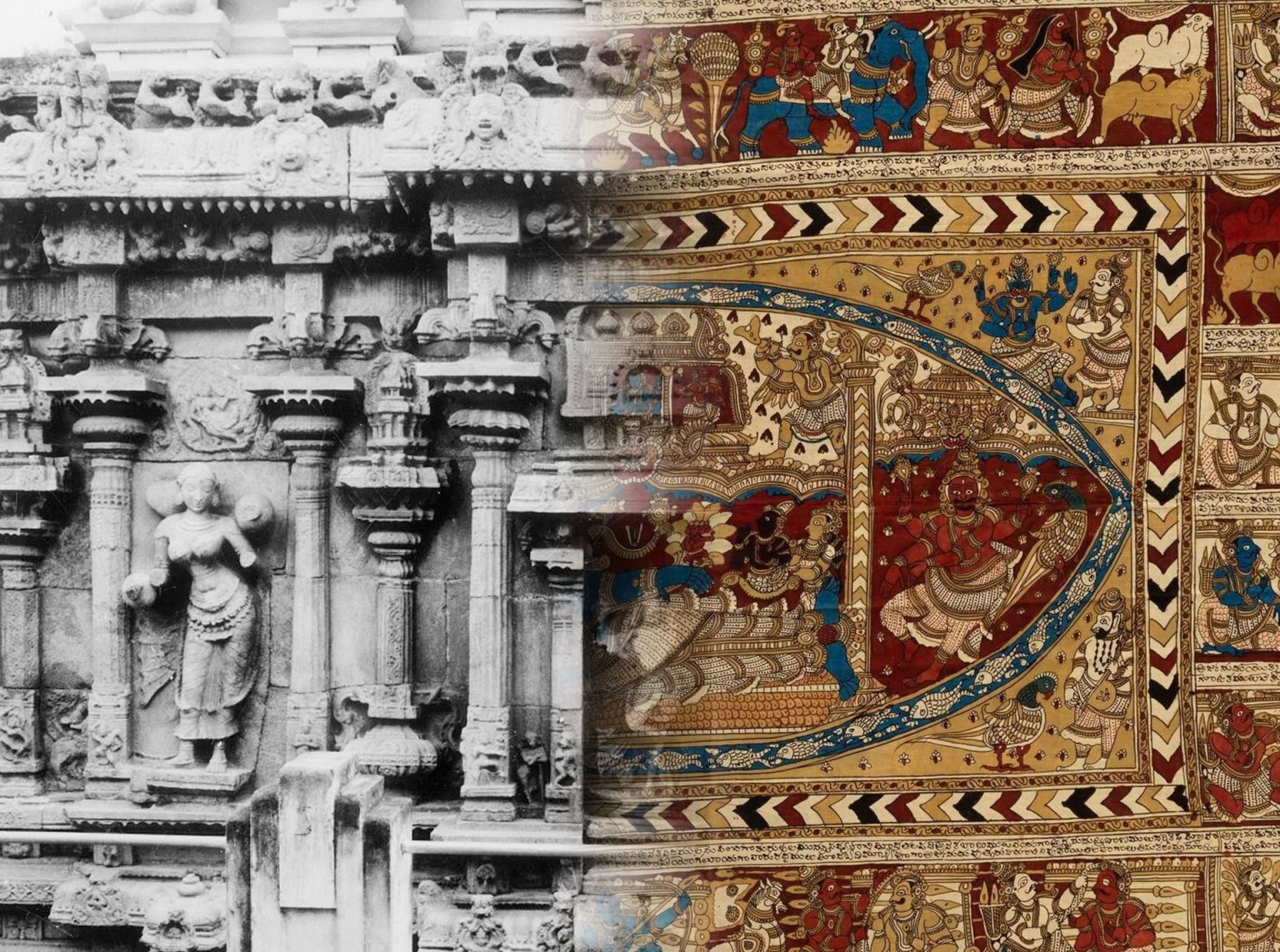
John Weaver for the project “Dressing Flesh and Stone: Connections Between Architecture and Textiles in Andhra Pradesh”
This exhibit seeks to enrich our understanding of architecture and textiles within South India by highlighting their shared qualities, both in form and meaning. We will take the temple—and more specifically, sacred space as an idea—as the common ground for comparing the two traditions, as they often meet in close proximity here. Taking Andhra Pradesh’s vibrant textile and architectural history as an example, we will discover how highly mobile cloths can create sacred space just like temples can. Further, we will find that the idea of dress—simply, covering something with something else—can actually link the two mediums, as both stone and flesh are transformed when laden with ornament.
Anjali Yadav for the project “Eternalizing the Ephemeral: Invitations As a Window to Arangetram in Bharatnatyam”
This exhibit focuses on ephemera, a category in the archive that is born out of a collector’s lifelong passion about a subject. One such person was Sunil Kothari, whose practice of saving everything from seemingly trivial pieces of paper to important documents is now a gift to the field of Dance Studies in India. Kothari was a well-known critic and a scholar of dance. One of the limitations of any collection is that it only reflects the collector and their field of interests. Therefore, this exhibit, in no way attempts to generalize the theme of Arangetram in Bharatnatyam. Rather, it should be seen as an analysis of a collection, by a particular collector. The Performing Arts Ephemera Collection of Sunil Kothari has over 4,000 documents in total, neatly categorized in folders which have been created not using standard classification systems but creating categories which may be relevant for research. Arangetram appears as a separate category in the collection though being related to the classical dance form of Bharatnatyam, because of its potential as an area of research. The Arangetram folder contains principally invitations from India and abroad.