
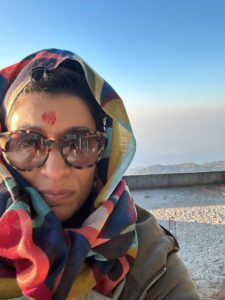
 Aarti S. Madan is an Associate Professor of Spanish & International Studies in the Department of Humanities and Arts at Worcester Polytechnic Institute. Her research interests include questions of national identity, spatial & environmental humanities, and transnational feminisms in Latin American literary and visual culture.
Professor Madan is currently an AIIS Senior Fellow working on her project “Familiarity: India in the Argentine Cultural Imaginary.”
Can you tell us a little bit about your transnational research and your fellowship with AIIS?
As an interdisciplinary scholar, I’ve long centered my research on Argentine and Brazilian cultural production, focusing primarily on questions of national identity, spatial & environmental humanities, and transnational feminisms. I’ve published on figures as far-ranging as Domingo Faustino Sarmiento (a prolific and poetic proponent of modernization through whitening the national landscape and one of nineteenth-century Argentina’s most influential, and genocidal, presidents) and Panmela Castro (a widely acclaimed contemporary Afro-Brazilian street artivist famous for painting Black women’s bodies onto the façades of buildings worldwide). In tune with this spatial impulse, my first book—Lines of Geography in Latin American Narrative (Palgrave, 2017)—takes a geocentric approach to position literary writing, nation building, and discipline formation as mutually informative phenomena across fin-de-siècle Latin America. I’ve always sought to connect disparate times, spaces, and genres to make meaning out of contradictions or counterintuitive relations, even and especially when they’re not immediately obvious. No matter whether it’s in Buenos Aires or Brazil or Bangalore, my research is comparative at heart and seeks to bridge places, peoples, and producers of knowledge, giving voice and volume to marginalized histories.
I’ve thus grateful that the AIIS awarded me a generous Senior Scholarly Development Fellowship in support of my current book project, Familiarity: India in the Argentine Cultural Imaginary (1926-2023). In keeping with my previous work, this transnational research pays no heed to restrictive temporal or geographic parameters and instead traces an unexpected arc of solidarities between India and Argentina from the interwar period to present day. The project broaches two overarching research questions: (1) How has familiarity with the Indian subcontinent informed Argentine aesthetic, religious, and political ideas for roughly a century (1926-2023)? and (2) How does tracing a literary and cultural history of Indian-Argentine relations change our understanding of contemporary categories like nationalism, appropriation, Eurocentrism, and Orientalism?
I answer these questions by reconstructing a fascinating, almost soap-opera-esque tale about an interrelated set of figures with deep familiarity with India, from the elite national writer Ricardo Güiraldes and his wife Adelina del Carril—whom I read as a writer and thinker in her own right—on to Ramachandra Gowda, an Indian national adopted by del Carril while she lived adjacent to the Ramakrishna Math in Bangalore from 1939 onward. Gowda, who called her Mamita, returned to Argentina with del Carril in 1951 and, after her passing, became the sole heir to the Güiraldes literary estate, much to the chagrin of Argentina’s white literary establishment. Little is known about del Carril and Gowda’s time in India or the nature of his adoption, thus I devoted my fellowship period to conducting archival research and semi-structured interviews to better understand these two understudied figures and their writings, specifically vis-à-vis philosophies of the Vedanta.
How did you bring India and Argentina together?
I’ll approach this question as both a WHY and a HOW, because I believe both are equally important. As an interdisciplinary scholar of Latin America and the child of Indian immigrants, I’ve long wanted to bring these two regions together. My father was born in June 1947 in Jaranwala, which was, on the day of his birth, northern India. In August 1947, an imaginary line was etched onto political maps. My Hindu-Sikh grandparents, eldest uncle (age two), and father (age two months) became refugees with Partition. Though I was born in Chicago nearly forty years later, I inherited the enduring legacies of trauma and experienced the fractured identities caused by migration, colonialism, and shifting borders. But at each stage of my formation—from undergrad to grad to the professoriate—Latin America has taught me about subalternity and coloniality, about India, and about myself. It has healed my split self. While my first book emerged from my interest in the social and literary construction of borders, spaces, and identities, my second book explores the lines that connect India and Latin America. The figures I study in Familiarity are all too familiar to me. Caught between spaces and lands, they wanted unity. They wanted peace. They wanted answers. Some found answers in Argentina, others in India. I hoped to find some there, too. More than anything, I hoped to tell their story—for them, for us, and for the world. I’m confident that I made progress toward both goals during my fellowship period, which leads me to the HOW.
On the one hand, I examine how exported Indian epistemologies enabled members of the Argentine elite to imagine an alternative path for Western society, which was devasted by the horrors of World War I. As I show in Part I, early-twentieth-century intellectuals like Güiraldes and del Carril drew on Vedic ideas of non-dualism to expound a discourse of unity. Anchoring my argument on the etymology of yoga—derived from the Sanskrit root yuj, meaning “to join” or “to unite”—I demonstrate that Güiraldes’s Yogic practice informed his most critically acclaimed novel, Don Segundo Sombra (1926). My reading, which looks to the author’s understudied diaries as well as unpublished archival materials, offers fresh insight into this canonical text. I furthermore center del Carril in her husband’s spiritual and creative process while revealing her centrality to a web of Latin American Indologists and to proto-feminist activism in Latin America. Drawing on my AIIS research conducted at the Ramakrishna Math in Bangalore—where del Carril studied for a dozen years—I theorize the ways in which Vedantic tenets led her to espouse a cosmopolitan feminism committed to eliminating all dualities, be they of class, credo, or color.
On the other hand, my project examines how a new generation of Indian-descendant thinkers have leveraged these South-South relations to foreground matters of race and belonging. Part II thus explores how individuals like editor Ramachandra Gowda and filmmaker Andrés Di Tella (Argentine-Indian son of Torcuato Di Tella and Kamala Apparao) refracted this earlier view of India through the lens of their racialized experiences. I close the book with an analysis of José Rivarola’s Los recuerdos vivos: una vida legendaria entre la India y la Argentina, basada en hechos reales (2023), a historical novel that draws on real interactions between the author and Gowda to fictionalize the entanglements between the figures I study and, more importantly, between India and Argentina. With this conclusion, I aim to showcase the contemporary and continued relevance of India in the Argentine cultural imaginary. Through a close reading of diverse genres—epistolary, diary, travel, poetry, novel, film, footnote, marginalia, periodical, and even graphic—my intervention promises a richly textured study of the role India has played in forming and flouting Argentine culture for nearly one hundred years.
Can you tell us a little bit about your methodology? What challenges did you face bringing together India source materials with your materials from Argentina given different formats and languages?
To carry out this analysis, I’ve assembled a unique and expansive corpus of canonical and extracanonical works, including understudied and unpublished correspondence, diaries, essays, and even blog posts by Güiraldes, del Carril, Gowda, and Di Tella but also by other writers (e.g. D.F. Sarmiento, Lucio Vicente López, Gabriela Mistral, Victoria Ocampo, Adolfo Obieta, Sophia Wadia, José Rivarola) who unanimously point to alignments, divergences, and collaborations between Argentina and India. I’ve complemented and enrichened my close reading of primary sources central to India-Argentina relations with fieldwork. I’ve conducted extensive interviews in both countries and have found rich archival materials in Argentina (Biblioteca Nacional, Museo Gauchesco Ricardo Güiraldes, Ramakrishna Ashrama Argentina) as well as in India (Ramakrishna Math Bangalore, Ramakrishna Math Ulsoor, Indian Institute of World Culture).
More specifically, I spent five days of the AIIS fellowship period in Rishikesh, where I aimed to dive deep into the practice of yoga and the philosophy of the Vedanta, both integral components of my work on Indian-Argentine relations. I studied philosophy with Acharya Siddant—a disciple of Ramana Maharshi, with whom Ramachandra Gowda studied as an adolescent in Arunachala—and practiced yoga twice daily with gurus specialized in Hatha, Raja, and Ashtanga practices. I also partook in guided meditations that helped me consider the role of silence in the works I study in my project.
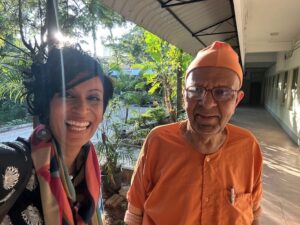
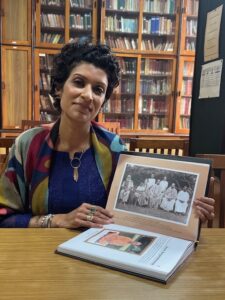
I spent the bulk of my fellowship in Bangalore. With support from the head librarian Satish L.A., I mined the rich archives of the Ramakrishna Math in Bangalore and was able to uncover unnamed photos of Adelina del Carril and Ramachandra Gowda that have not circulated, to my knowledge, in Argentina or the United States. I interviewed several individuals who knew of or who had even met—in the case of a 103-year-old retired anesthesiologist (Dr. K.R. Chandrasekhar) and an 86-year-old retired monk (Swami Sukhatmananda)—del Carril and Gowda.
Most importantly, through the photos, I succeeded in identifying Swami Tyagishananda as the guru who most impacted del Carril’s thinking. His presidency of Bangalore’s Ramakrishna Math coincided wholly with her stay in Bangalore; she arrived in India in 1939 (a year after he became President) and returned to Buenos Aires the year he died, 1951. I was able to scan several of his published volumes. I also asked Satish ji in the Ramakrishna Math library if he could point me in the direction of further information on Swami Tyagishananda. He suggested I contact the Ramakrishna Math in Ulsoor and ask to be put in contact with Swami Sukhatmananda. I did so, and a little over twelve hours later, I received an enthusiastic email from Swami Sukhatmananda—the 86-year-old retired monk—explaining that he knew the Gowda family intimately and was familiar with “Mamita,” as del Carril was known in India. I interviewed him and was immediately able to connect several dots with his help. After earning his trust, I learned that his uncle, Swami Kirtidananda, had been Tyagishananda’s disciple and even appears in the photographs I found that feature del Carril, Gowda, and Tyagishananda. As luck would have it, Kirtidananda took meticulous notes during Tyagishananda’s lectures. He left these crumbling notebooks to Swami Sukhatmananda upon his passing. For this last several years, Swami Sukhatmananda has devoted himself to scanning and transcribing these lecture notes. I am honored and humbled that he agreed to share these notes with me. My access to these unpublished materials will allow me insight into the ways in which Tyagishananda’s teaching informed del Carril’s thinking, seeing that she very likely attended these same lectures or at least was privy to this line of thinking.
As for the challenges inherent in any fieldwork—be it ethnographic or archival or what have you—the most immediate difficulty was simply acquiring source materials. In Argentina, I was met with a bit of side-eye at the Museo Gauchesco Ricardo Güiraldes, where the caretakers are vested more in Güiraldes’s representation of the gaucho and less in his knowledge of Indian epistemologies; they weren’t too receptive when I ask asked about del Carril and Gowda. At the Ramakrishna Ashrama, I encountered silence regarding del Carril and Gowda’s time there. Only after sharing these challenges on social media did I succeed in overcoming them: a grad school friend sent me a surprising DM telling me that not only was her ex-father-in-law deeply invested in this convoluted tale but that he was a dear friend and confidant of Gowda’s. She put us in touch, and slowly but surely over the course of several Zoom conversations, I gained deeper insight into his story. I also learned of Gowda’s many edited volumes, which were printed in small batches and poorly circulated. As only serendipity would have it, my grad school friend had received several of these copies from her then-father-in-law, and she had donated them to the University of Pittsburgh’s Hillman Library, which is where, incidentally, I drafted what became my first book. I’ve since acquired these works through Interlibrary Loan and have also had several fruitful conversations with another individual intimately intertwined in Gowda’s orbit.
In India, my most immediate challenge was convincing the head librarian that it was I, in fact, who was Dr. Madan! In our first interactions I presented my letter of introduction from the AIIS along with my business card. He told me he had no materials related to my query and took the letter and card back to his office. I sat down and perused a stack of books anyhow. An hour later, he approached me and asked, “But let me ask you one thing, WHO is Dr. Madan?!” I took great satisfaction in pointing at myself, smiling widely, and responding, “me!” From there our relationship absolutely transformed, and he was an essential conduit to acquiring texts and putting me in touch with the right people. I had to gain his trust and convince him to take me seriously, however.
As for wedding these two source materials, it has been a match made in heaven. The references I acquired in Buenos Aires often had a direct corollary in Bangalore, and they’ve been mutually informative. More concretely, I succeeded in making meaning of Spanish-language references to Indian figures or Vedantic philosophies by identifying English-language texts in India to give me context. Fortunately, many of the publications housed in my primary and secondary archives in India were composed in English. One exception stands out. During my interview with Swami Sukhatmananda, I learned that Ramachandra Gowda’s father—Chenne Gowda—had authored a biography of Ramakrishna. Though the Swami doubted that the book would still be in circulation, I succeeded in locating this Kannada-language volume in the library of the Indian Institute of World Culture. I scanned it and sent it to Swami Sukhatmananda, with whom I’ve been in continuous contact since returning to the United States.
In what ways does this kind of globally connected research change the landscape of India studies?
Each of the figures I study reflect on their position in the world from the interstices between Argentina, India, and Europe. At the same time, they connect these ostensibly disparate lands. I’m thus looking to extend the reach of Global South studies by reconceptualizing geographic space and the movement of humans and ideas as continuous and connected, rather than contained. I also subscribe to the idea of Asia-Latin America as method to dislocate the west. This sort of globally connected research can change the landscape of India studies by expanding the notion of region and deepening our knowledge of long-neglected South-South cultural encounters. My work relies on a theoretical framework built upon Indian philosophies, deploying them to make meaning of Argentine aesthetics and politics over the course of nearly a century. Refusing to prioritize theory originating in the North, Familiarity provincializes Europe and the United States while positioning Argentina-India as an epistemological lens though which to examine Global South networks. This approach thus challenges our understanding of the geopolitics of knowledge production, shifting the region from a passive object of study—a vestige of Cold War area studies paradigms—into an active site of creation.