
The Edward Cameron Dimock, Jr. Prize in the Indian Humanities was awarded to Tyler W. Williams for If All the World Were Paper: A History of Writing in Hindi
The Joseph W. Elder Prize in the Indian Social Sciences was awarded to Andrew McDowell for Atmospheric Entanglements: Caste, Contagion, and Care in Rural India
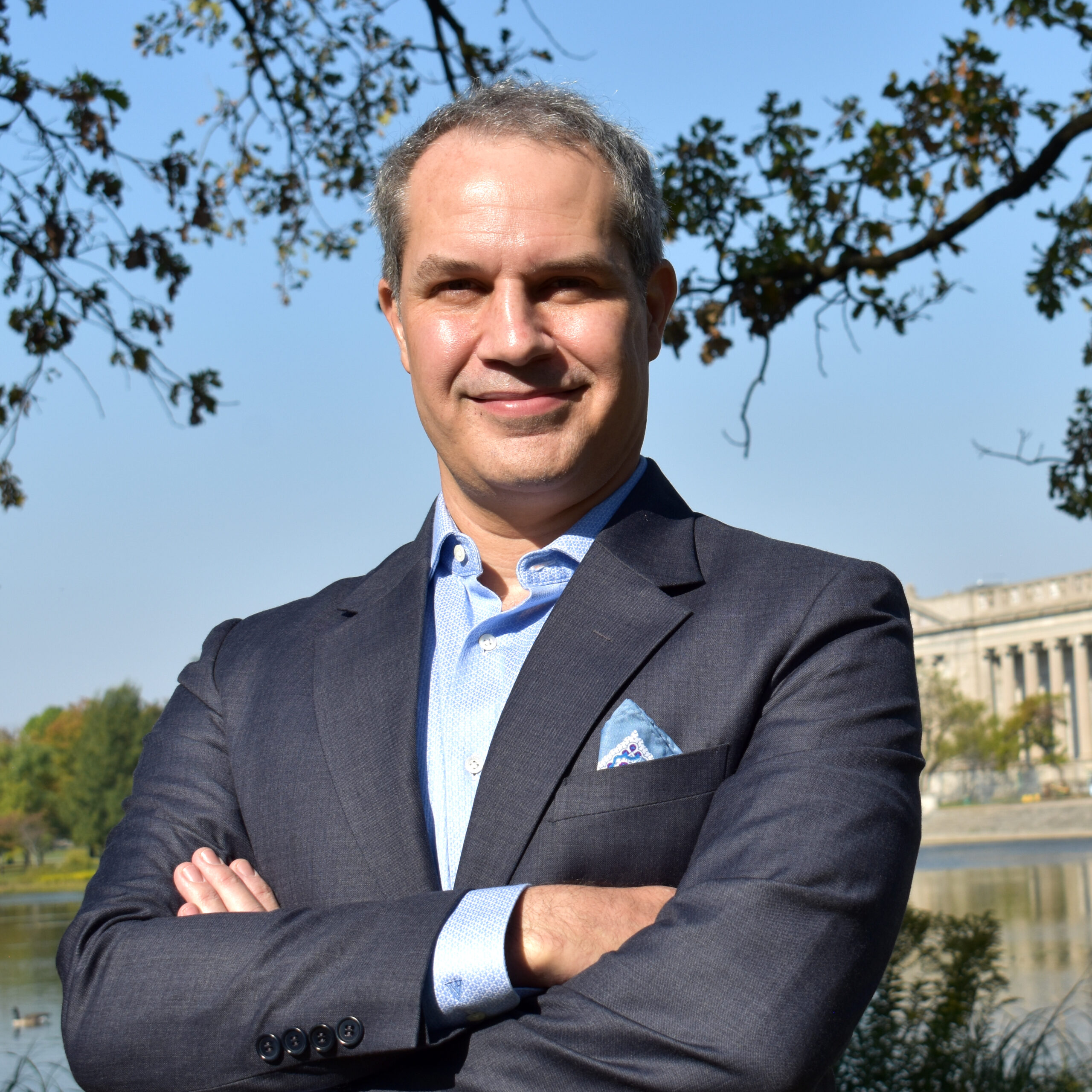
Tyler Williams
Tyler Williams’s If All the World Were Paper: A History of Writing in Hindi tells the story of how bhāṣā, the vernacular language of northern India now known by the term ‘Hindi,’ came to be written down and transformed into a language of literature, scholarship, and scripture. He argues that the material technologies and practices of written inscription, together with specific modes of using written works in literary, pedagogical, and liturgical performance, shaped the development of vernacular literary genres and distinctly vernacular types of ‘books’ during the fourteenth through eighteenth centuries. Combining technologies, lexicons, and linguistic ideologies from the Sanskrit, Persian, and vernacular traditions, composers, artisans, and scribes collectively established conventions for the inscription of Hindi and the arrangement of books; some of these conventions have made their way from manuscript culture into the modern printed book. Combining close readings of literary and religious works with an examination of several hundred manuscripts from the sixteenth through eighteenth centuries, Professor Williams reconstructs four scenes of writing in early modern north India: that of the allegorical romance, the devotional hymn, the pedagogical treatise, and the scriptural anthology. Each of these scenes comprised a set of material, social, and literary practices that corresponded to certain ideologies of writing and particular ways of inscribing and using books. The book ends with an exploration of how the archival, museological, and scholarly practices of the twentieth century transformed the richly variegated landscape of premodern written artifacts into a linguistically and religiously disaggregated—but materially homogenous—’archive.’
The AIIS Book Prize Committee praised Professor Williams’ manuscript, saying, this “elegantly written and admirably researched study offers new insights into and original readings of Sufi romances, bhakti poetry, scholastic literature, and scripture written in the various scripts and vocabularies comprising early modern Hindi. Its main contribution is to shift literary studies away from privileging the textual content of north Indian manuscripts written around the sixteenth to the nineteenth centuries towards an understanding of their material form—how these manuscripts were produced and by whom, what they looked like, the paratexts and visual representations accompanying the texts, and the routes through which they circulated. This history of writing in Hindi offers a novel understanding of the concept of the vernacular and processes of vernacularization in premodern India.”
Tyler W. Williams is an associate professor in the Department of South Asian Languages and Civilizations at the University of Chicago. He received his Ph.D. from Columbia University in 2014. His research focuses on the philological and historical study of literary and religious texts in early modern north India (ca. 1300-1800 CE)—in particular those composed in the languages now known as Hindi/Hindavi/Urdu. He is especially interested in the relationship between the form and function of material texts—i.e., manuscripts, including their production, circulation, and use in performance—and the generic, aesthetic, and performative character of the literary and religious works that they contain. His research also touches upon more general issues of literary and visual aesthetics in both the precolonial and postcolonial periods. In 2020 he was awarded an AIIS Digital Scholarship Grant for “The Afsana Project” which he carried out in 2021.

Andrew McDowell
Atmospheric Entanglements, to be published by Stanford University Press in 2024, is an ethnography of troubled but shared life in rural Southeast Rajasthan, India. The book focuses on a small Dalit and Adivasi community within a global TB epidemic to argue that situated accounts of breath and breathing are key to understanding our shared challenges of living. Based on ten years of ethnographic exchange with families, neighborhoods, and Indian public health around TB, Atmospheric Entanglements is an intimate story of human and bacterial bodies and futures. Its fine-grained account of TB and caste’s effect on individual and social breathing reveals vibrant and creative practices of atmospheric care and commitment. Writing against public health discourses that present Indians afflicted by TB as abject or resistant subjects, the book is organized around collective rural creativity and care for breath in atmospheres of, dust, air, mud, clouds, forests, and afterlives. Breath, the book’s protagonists show, is a connection that links people and spaces to extend the body beyond the skin and care beyond touch. Indeed, the atmospheric lives and practices that Atmospheric Entanglements outlines are replete with modes of perseverance which simultaneously care for both individuals and worlds. Put simply, the book shows how practices that simultaneously attend to sickness and the world are essential for life brought together by breath. A moral and medical anthropology, Atmospheric Entanglements speaks to the deeply social nature of bodies and medicine and reframes our understanding of hope in the face of unavoidable but unevenly distributed danger. Atmospheric Entanglements brings conversations in Dalit Studies, global public health, ecology, and development together to give readers a sense of how people make meaning when their TB-afflicted breath requires that they traverse these epistemological fields with their own values and ways of knowing. It follows Dalit and Adivasi families to hospitals and sits with a young boy as he fans his bedbound father. It gazes longingly at the forest with a man whose treatment for drug resistant tuberculosis prevents him from entering it and searches the clouds for revelations about moral affliction. It visits a rural clinic covered in the dust of development and public health politics and listens to the voices of wheezing ghosts. On each page it listens carefully to the ways people affected by TB make sense of and work on their entanglement with atmospheres. What emerges is a carefully and beautifully written story about how to care for something as diffuse and ephemeral as breath.
The AIIS Book Prize Committee wrote of this manuscript, “How do individuals, families, and communities experience and live with tuberculosis in contemporary rural India. Andrew McDowell’s engaging study of a Rajasthani village and its locality offers a rich and compelling ethnographic account of the “atmospheric” or ecological conditions under which people with TB and their caregivers operate. In seven striking stories about “life and breath with TB,” this manuscript recounts how individual lives affect and are affected by social relations pertaining to caste, gender, kinship and care, as well as by larger political and economic changes. These wonderfully narrated stories highlight the limitations of understanding solely in terms of public health and medicine without consideration of environmental elements such as air, dust, mud, and space that significantly shape the everyday well-being of ordinary people living with tuberculosis.”
Andrew McDowell is a sociocultural and medical anthropologist whose scholarship focuses on global public health’s social and technological work to know and manage tuberculosis as a project of development in India and globally. He is an assistant professor of anthropology at Tulane University and received his PhD in anthropology from Harvard University. He participated in the CLS summer Hindi program operated by AIIS while an undergraduate at the University of Iowa in 2006 and held an AIIS junior fellowship in 2011-2012. He also received postdoctoral fellowships at McGill University (Canada) and L’École des Hautes Études en Sciences Sociales. In addition to Atmospheric Entanglements, he has written essays exploring the lived experience of caste categorization, the use and circulation of pharmaceuticals in rural India, ghostly concerns for indigeneity in Southeast Rajasthan, and the practice of medicine in Mumbai. He has also co-written Global Health for All (2022) about the emergence and practice of global health. He is now working on a second book project that traces the introduction of molecular diagnostic tests and the production of diagnostic value in Mumbai’s urban storefront clinics. His WHO-funded research has also informed the newest global TB care guidelines.
The 2022-23 AIIS Book Prize Committee included Sarah Lamb and Anand Yang, co-chairs, Chanchal Dadlani, Sonal Khullar, Preetha Mani, Tulasi Srinivas, and Tariq Thachil