
An AIIS team carrying out work for the project “Documentation of 16th-17th Century Mughal Monuments on the Grand Trunk Road” was visited by U.S. Embassy in India officers Gloria Berbena, Minister Counselor for Public Affairs and Mandeep Kaur, All India Principal Program Advisor from June 11 to 13, 2024. The project, which is being funded by a generous grant from the Ambassadors Fund for Cultural Preservation, is documenting approximately 60 monuments at historic sites along the Grand Trunk Road and recording oral history by interviewing local communities in order to explore their connections to the built heritage with which they live. These monuments survive along a 16th century imperial highway which was divided about 75 years ago by the partition of the north-western part of the Indian subcontinent in August 1947 and which now exists in fragments on both sides of the Line of Control in India and Pakistan. This project will create a free, globally accessible online digital research resource on this highway which has never been documented in its entirety.
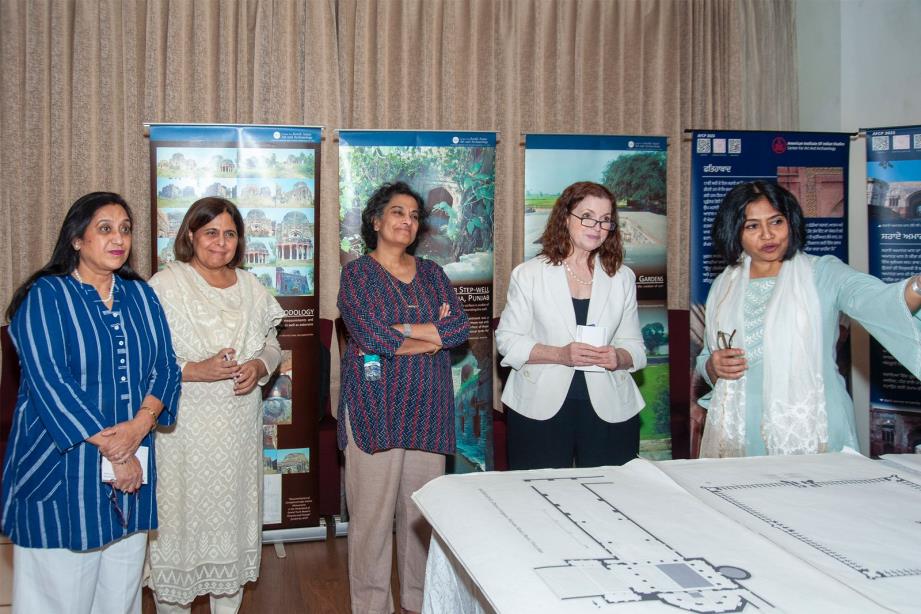
The visit commenced with a powerpoint presentation and exhibition at the Hotel Hyatt in Amritsar, which provided an overview of the project. AIIS was represented by director-general Purnima Mehta, AIIS president Sumathi Ramaswamy, and director of the AIIS Center for Art and Archaeology Vandana Sinha.
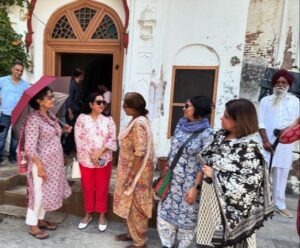
On June 12 and 13, Ms Kaur accompanied the AIIS team on their visit to the highway in Punjab, demonstrating the procedures for documenting oral and architectural aspects of monuments. Ms Kaur toured the Raja Taal area and observed a distance marker and a large water tank located about a quarter mile away from the border. The tank was originally constructed by the Mughal State Council Head, Raja Todar Mal, and has since been converted to farmland.
Ms. Kaur participated in interview sessions conducted by the AIIS team at Sarai Amanat Khan, the last Way station in Punjab. During the interviews, some elderly residents recalled the heyday of the Mughal highway and how the route became insignificant due to the partition. A few Khatri (merchant class) families still living inside the Way station shared that Sarai Amanat Khan, named after its benefactor Amanat Khan, was once a flourishing market until the partition. Ms Kaur then travelled with the AIIS photo and architectural documentation team to explore another way station situated 70 miles from Sarai Amanat Khan in Punjab, commonly known as Sarai Dakhni after its patron, Rustam Khan Dakhni. During the visit, the team showcased architectural measurement techniques and produced the ground plan for the impressive gateways of the way station. In addition, the team’s photographer and documentation officer captured images of the way station and compiled image metadata for the AIIS database.
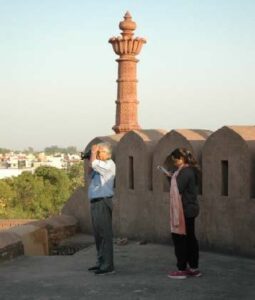
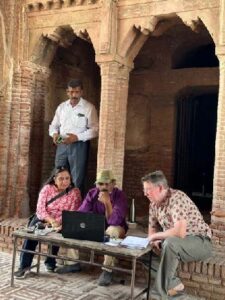
Documenting a 17th-century Way station called Sarai Dakhni
The AIIS team, working in 113 degree Fahrenheit heat, has so far documented 32 monuments in Punjab. The project has facilitated the documentation team with high-end digital cameras for photography and modern equipment for digitally creating measured architectural drawings in AutoCAD. The interviews are recorded on sophisticated audio equipment for archival-quality sound recording.